Nothing Else Compares. Nothing Else Matters.
Reflections on Argentina, refereeing, and the her

On July 16,—tomorrow!—we’ll be hosting an event with writers Rory Smith, Simon Kuper, Leander Schaerlaeckens, and Ishaan Tharoor at McNally Jackson’s Downtown Brooklyn event space located at 1DeKalb Ave! Please RSVP here!
I live in a residential, somewhat peripheral neighborhood of Buenos Aires, Villa del Parque. A block away from me, facing the pleasant Villa del Parque square, is the Club Social y Deportivo Parque, a small neighborhood institution for whose futsal team one Diego Maradona once played a final, in 1991, while serving out his doping ban. The club shaped other Argentine greats: Juan Román Riquelme, Juan Pablo Sorín, Fernando Gago, as well as current Argentina player Alexis MacAllister all got their start there. Argentinos Jrs.’ Estadio Diego Armando Maradona, where the man first became an icon, is a few blocks away from my house as well. This neighborhood, quiet and unremarkable, burns with footballing intensity and is haunted by its ghosts.
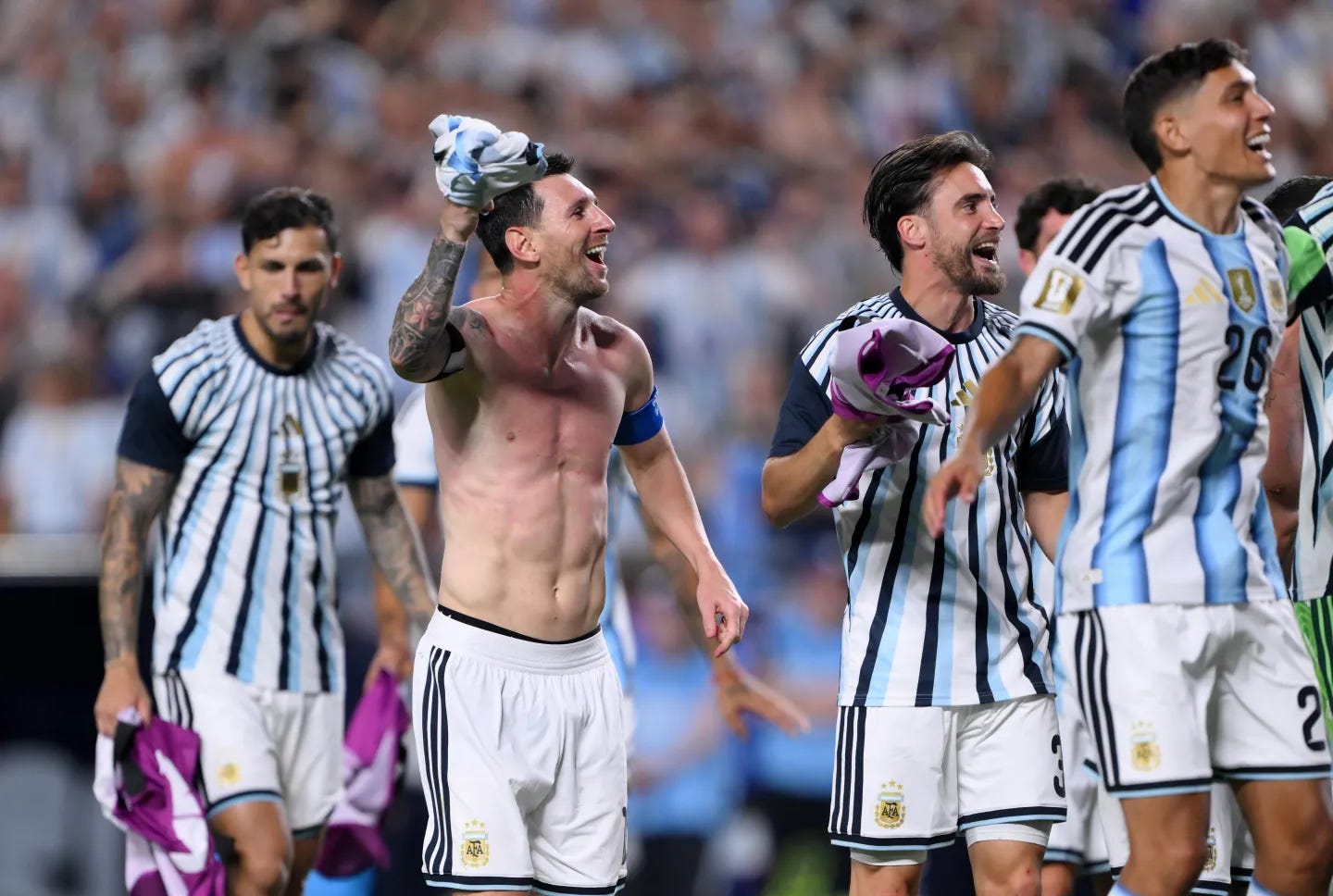
After every agony-filled triumph of this Argentina team—against Egypt, at 3PM on a Tuesday; against Switzerland, at midnight on a Saturday—the corner of that same square, which my balcony faces, has exploded into a sea of blue and white a thousand people strong. Last Tuesday, it was mostly kids from a nearby school, all of whom were let go early and decided to mosh as they sang one of a thousand songs with glee. Both days, someone cut off my street with a trash can or a chair and, for two hours or more, the singing and dancing did not cease, the mass did not move or break. Somehow, flags and instruments manifested: drums, a trumpet, the cancha essentials. Parents raised their children on their shoulders, decked them out in flag colors or kicked footballs on the periphery. Fireworks often go off rather dangerously.
My square is no exception: every square in the city and, dare I say, the country, is like this. But after the Switzerland match, when we knew England was next, there was only one song to sing: “y ya lo ve/ y ya lo ve/ el que no salta/ es un inglés.” Nevermind that the song used to be about the Dutch: it might as well be our national anthem. Since Saturday, collective psychosis has taken hold. Tickets to watch an indie documentary about the 1986 match where Maradona humiliated the English—only on display in two theaters in Buenos Aires—have sold out. I’ve seen approximately one million different compilations of his goals (and Zanetti’s in 1998). Candles are being lit near Maradona’s former apartment at the intersection of Segurola and La Habana streets. No Argentine has thought or discussed anything else. The nation vibrates apocalyptic and few will have slept the night before, myself included.
I have little analysis to offer you, dear reader – nerves will be the main factor between two evenly-matched teams. Both have, I think, been broadly worse than they should be all tournament, mostly gotten by on individual genius and guts. Never in my life has the pulse of the city run so quick. This team and this man—you know who—have already won Argentina a World Cup, and yet. Nothing else compares. Nothing else matters. —Federico Perelmuter
Of course, I think Alexander Sørloth should have passed. Erling Haaland was completely open, Jordan Pickford has small arms, and Jude Bellingham surely can’t score every single goal England needs. The aftermath of Norway’s loss has prompted some surgical psychoanalysis of Sørloth’s perceived greed, which must come from a biblical jealousy of Haaland, who has relegated him to being the 6-foot-5 Norwegian no one knows. More than a few people have seen a Machiavellian streak in Sørloth’s non-pass, a desire to steal a moment of personal glory at the sacrifice of the team and the Norwegian nation.
For me, there are a few more wrinkles. John Stones does a good job in a Virgil van Dijk-Moussa Sissoko style situation, where all he’s trying to do is introduce doubt. Later, Sørloth, explains, in a slightly sad way, that he took a poor touch. The replay bears this out: Sørloth slows down inexplicably and the split-second window for the pass closes, at which point the only thing he can do is cut inside. The fault is technical rather than moral—even if there is an element of self-interest, it is instinctive, a flash of a thought. But the narrative is there and Sørloth is a plump, broodish scapegoat.
At this stage of the tournament, the margins are incredibly fine. Half of the quarter-finals were lost because of a routine save being spilled. It’s a prime stage for villains to be christened; what we want from players is a purity of intention, instinct, action. To be honest, my main focus has been the true villains in the crowd, like the Paraguayan senator Celeste Amarilla. So incensed by Kylian Mbappé not immediately shaking hands with the Paraguayan goalkeeper, Amarilla achieved a flow-state of pure, unadulterated racism, which prompted global condemnation and a sharp, elegant rebuke from Mbappé himself. In the past week, she has simultaneously double downed, warned Mbappe not to mess with Paraguayans, threatened to sue him for gender-based violence, and also lightly retracted her statements, admitting that yes, it was racism, which she detests, but also a heat of the moment response, a blunder influenced by the norms from a different era.
Perhaps, as Amarilla claims, these are all the natural spasms of the work-in-progress that she is—one for whom we, the public, should have patience. After all, how are you meant to undo that kind of hard-wired instinct? In her extended non-apology, she calls Mbappé a son of a bitch and then states she is in the process of “deconstructing” herself: “I am trying to build a different Celeste Amarilla.” —Andy Tan-Delli Cicchi
How long will the halftime show at the 2026 World Cup Final be? No one really seems to know. FIFA has said that it is targeting a 20-minute break, but that seems improbable given that it will feature a Super Bowl-esque performance featuring a line-up (curated by Coldplay’s Chris Martin!) featuring Justin Bieber, Shakira, BTS, Madonna, Burna Boy, Venezuelan conductor Gustavo Dudamel and the PS22 Chorus. According to The Athletic, “characters from Sesame Street and The Muppets will also be part of the show.”
I bear no ill will towards any of those people, with the possible exception of Martin—though age has blunted my antipathy toward Coldplay—and find it hard to get worked up about the “halftime show,” even if I do think it is stupid and absurd. There has, predictably, been grousing about how this is yet another example of FIFA bending its rules (in this case, a rule mandating that halftime lasts 15 minutes) for its own sinister purposes.
Still, the complaints about the halftime show fit into what I think is a largely fair critique of how FIFA has handled this World Cup: That it has shamelessly and willfully ignored or bent its own rules when it suits its larger interests. There is, of course, no better example of this than the red card that was (unfairly) given to Folarin Balogun during the United States’s Round of 32 game against Bosnia and then (even more unfairly) rescinded before its Round of 16 game Belgium. FIFA didn’t want a controversy hanging over its principal host nation, so it simply made it go away—and, of course, created a new, even bigger controversy in the process.
There have been many attempts to create a grand theory of corruption in the World Cup by tying these outrages to complaints about officiating, most of which revolve around the use of VAR. I admit that I have been frustrated by the application of VAR and the inconsistency of the refereeing, which I think has been generally poor. Still, I find the larger unified theory of malfeasance—that FIFA is intentionally manipulating outcomes at every turn—to be profoundly underwhelming.
There is griping about referring at every World Cup. There is, indeed, griping about officiating everywhere you look. If I am convinced—I think rightly—that more people believe in conspiracies now than they do, both in sports and elsewhere, it’s hardly new. (Today’s England - Argentina game, a fixture that comes with more than a half-century of complaining about conspiracies is a good reminder of this.) If the refereeing has been shoddy and inconsistent, though, I think that’s largely by design. It’s clear that FIFA has instructed referees to go light on the whistle and largely let teams play—and to let VAR do the dirty work of determining what is and isn’t a foul after the fact. This, ironically, largely fits what I think a lot of people want from elite soccer: They want the players to be allowed to play and they don’t want the game to be constantly stopped for fouls. But this has also led to the predicament we are in now, where pretty much everyone is convinced that FIFA is doing this to make its preferred teams do well.
I think this conclusion is absurd on its face, though. It requires a version of FIFA that is disciplined, sinister, and ruthless in its malfeasance. That’s just not what we’ve seen at all. Instead, what we’ve seen is an organization that has sloppily bent its own rules in ways that have always led to unforeseen consequences. Its meddling with the USMNT directly contributed to the thrashing that team received against Belgium. The halftime show is a stupid version of this, albeit a more harmless one. FIFA wants a long halftime show because it wants glitz and more commercials and now we have a situation where no one—fans, broadcasters, players—has any idea how long they’ll have to wait to get back on the field. It’s malevolent and it’s incompetent but it’s not part of an overarching conspiracy. It’s just how FIFA does business. —Alex Shephard
More from Golden Goal:
“In soccer, villains are not created through their actions alone. They walk onto a stage set by the loyalties, actions, misfortunes, and failures of those around them.” The poet Duy Đoàn revisits some of the most controversial moments in World Cup history here.
“In the Scaloneta, as we call the team, the values of the group mirror the value he instilled in the squad: the collective above the individual.” Read Guido Mignogna y Martín Rodríguez on Argentine coach Lionel Scaloni here.
"In the tradition of French predecessors including Thuram and Thierry Henry, [Kylian] Mbappé has openly weighed in on political matters, speaking out against the country’s far right." Read Laruent Dubois on Kylian Mbappé here.
“Despite the auction history of certain ’80s kits, it is the nostalgia of the ’90s that arguably powers the entire resale market.” Read Isabel Cristo on how the vintage resale market capitalized on the symbolism of old World Cup jerseys here.
“250 miles, $800+, 7 modes of transportation, and at least 5 QR codes later, my Stadium Fan Experience, my journey, was over.” Read urban planner Jonathan Tarelton on his journey to the World Cup here.
“The U.S. is unable to foster a tournament of global unity because of its own hardened identity of nationalism and exceptionalism, bolstered by FIFA’s claim to political neutrality.” Read Takashi Williams on the failures of the 2026 World Cup here.